
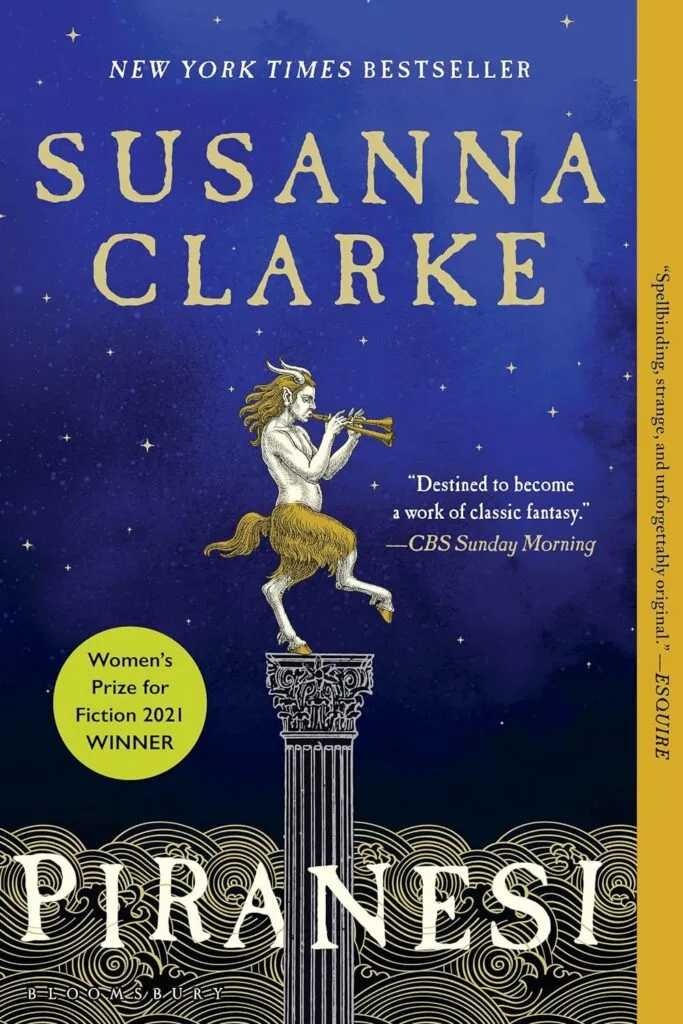
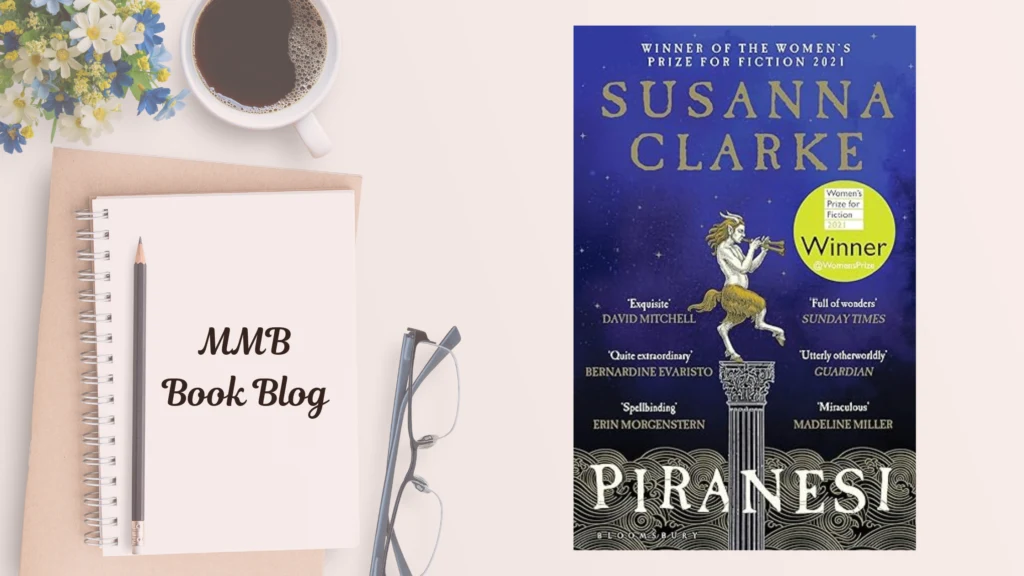
Piranesi is a novel written by bestselling author Susanna Clarke, published in 2020.
Susanna Clarke is the author of the hugely successful novel Jonathan Strange and Mr Norrell and Piranesi won the Women’s Prize for Fiction in 2021. It was also shortlisted for the BSFA Award for Best Novel.
The premise intrigued me as it sounded part literary fiction and part fantasy. I couldn’t wait to see what all the fuss was about.
Disclosure: This post may include affiliate links. As an Amazon Associate, I earn from qualifying purchases

Plot
Piranesi’s house is no ordinary house. The rooms, vestibules and staircases are infinite and within this labyrinth there are clouds above and gushing tides below. The house is Piranesi’s whole world. Piranesi is joined twice a week by his only friend – and only other inhabitant of the house – known only as The Other.
Piranesi assists The Other with his research into ‘A Great and Secret Knowledge’. However, as Piranesi explores his world, it becomes evident there is another person in the house. Piranesi begins to realise things may not be as he seems and there may be a world beyond what he has always known.
Piranesi Book Review

It’s very difficult to review a book like this as I’m reluctant to give anything away!
It was initially quite a confusing and disorientating read and I genuinely had no idea what was going on. However, the story slowly unravels and becomes clearer as the book goes on.
It’s wonderfully weird and imaginative and quite unlike anything I’ve read before. I struggled to get into it at first and the random capitalisation and constant talk of vestibules and staircases were a little off-putting, but I’m glad I persevered. Every time I put the book down I found myself thinking about it and keen to read a little more.
The book is full of imagery and symbolism and features various themes throughout, including religion and philosophy. The symbolism makes the story and its meaning quite subjective. Each reader may interpret it in a different way. Some will be looking for the deeper meaning while others will take it purely at face value. I love that level of ambiguity as it always makes it the perfect book to discuss.
Piranesi was a wonderful character and as the author subtly drops pieces of the puzzle, we start to question the reliability of the narrator but love him nonetheless. I am glad I knew so little about the novel before reading it so I could be taken on that journey of discovery along with Piranesi.
For a relatively short novel – approximately 250 pages in paperback – it certainly packs a punch. It’s an atmospheric and thought-provoking read which encourages the reader to look at the world in a different way.
I thoroughly enjoyed it.
What should I read after Piranesi?
If you’re a fan of contemplative, fantastical fiction I’d also recommend Sea of Tranquility by Emily St John Mandel.
If you’re looking for more books that have won The Women’s Prize for Fiction, I’d personally recommend Hamnet by Maggie O’Farrell, The Book of Form and Emptiness by Ruth Ozeki and Demon Copperhead by Barbara Kingsolver.