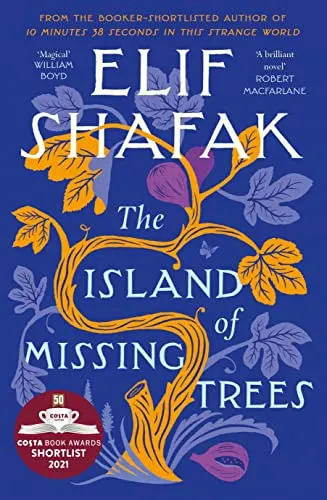
The Island of Missing Trees by Elif Shafak was released in 2021 and was shortlisted for The Women’s Prize for Fiction 2022. It was also shortlisted for the Costa Award and RSL Ondaatje Prize.
I recently read 10 Minutes 38 Seconds in this Strange World by Elif Shafak and I loved it. I therefore couldn’t wait to read The Island of Missing Trees.
Disclosure: This post may include affiliate links. As an Amazon Associate, I earn from qualifying purchases

Plot
In Cyrpus, 1974, teenagers Defne and Kostas are in love. However, Cyprus is divided and it’s a dangerous time to fall for someone on the opposite side.
Defne is Turkish and Muslim while Kostas is Greek and Christian.
The only place they can meet in secret and feel safe is a taverna named The Happy Fig. The taverna has a fig tree growing through a cavity in the roof, and it witnesses everything. From the young couple’s happy meetings to the devastation of the war.
In the aftermath of the war, Kostas and Defne are separated.
Decades later, a cutting of the original fig tree is smuggled to England by Kostas, who now works as a botanist. The fig tree lives in his London garden where Kostas lives with his sixteen-year-old daughter, Ada.
Ada is unaware of the fig tree’s origins and as she discovers more about the tree’s past, she starts to find out more about her own family’s history.
The Island of Missing Trees Book Review


This is another beautiful story by Elif Shafak. I just adore her style of writing. The prose is so lyrical and poetic but the story itself was also memorable.
On the surface, this is the tale of a young girl trying to find out more about her family and her place in the world. It’s the story of her family and how she came to live in England.
However, it’s so multilayered and full of symbolism. I loved how the roots of the tree symbolised the roots we put down as a family.
I really liked how the tree was a narrator and a character in its own right. It was really cleverly done and allowed a different insight into the events. It reminded me of the role of Book in The Book of Form and Emptiness by Ruth Ozeki.
While I’m certainly no botanist, I was still able to enjoy the details about the different trees and discussions about nature. It added a different dimension to the story. It perfectly highlighted how nature can so often be damaged by human conflict.
The book shines a light on the personal cost of a civil war. How futile it all seems when friends and loved ones are suffering all around you.
I found the brutality of the conflict contrasted perfectly against the kindness of the characters. There’s so much tenderness in Elif Shafak’s writing that it somehow makes the cruelties seem all the more shocking.
I really enjoyed Defne and Kostas’ love story. My heart ached for them both and everything they had been through. I could also empathise with Ada’s teenage angst and her desire to find her place in the world.
I found it clever how we learnt so much about Defne through the conversations and actions of others. It reminded me of Songbirds by Christy Lefteri, another book set in Cyprus, in the way the character was presented.
I have to mention that I absolutely loved Meryem, Ada’s aunt. I loved how she brought the family together with her wisdom and kindness and I adored her many anecdotes. She came across as such a force of nature but she too had her own vulnerabilities.
So to sum up, it’s definitely safe to say I LOVED this book. Elif Shafak’s writing just tugs at my heartstrings and I’m now on a mission to read every one of her books!
What should I read after The Island of Missing Trees by Elif Shafak?
If you enjoyed The Island of Missing Trees, I’d definitely suggest reading more Elif Shafak books. 10 Minutes 38 Seconds in This Strange World really leaves a lasting impression.
I’d also recommend books by Christy Lefteri, especially Songbirds and The Book of Fire.
This book is featured on the following list:
Related Book Lists
Related Books